
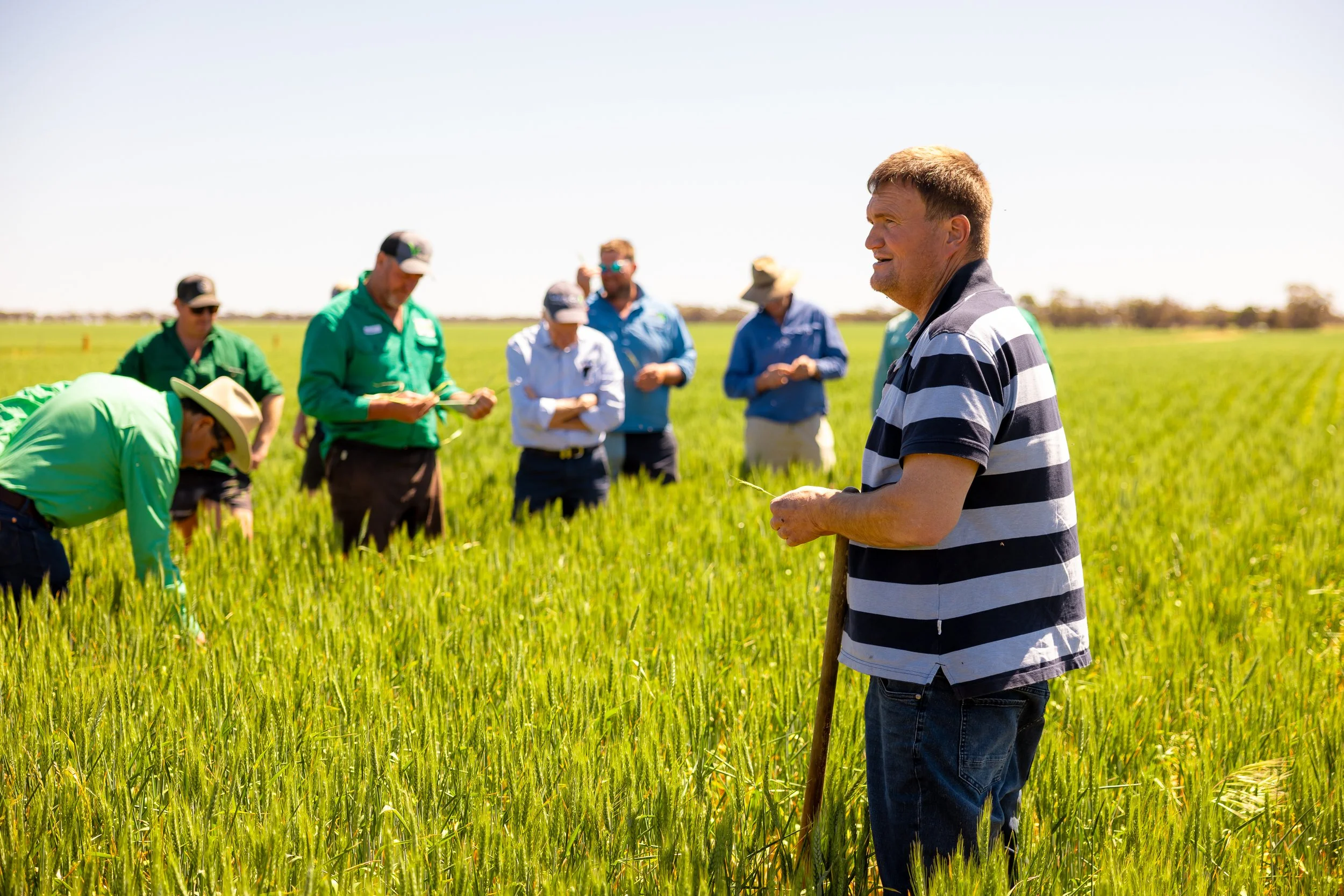
Nathan Kemp standing in his barley crop at Birchip (Oct 2025 field day)
382 carbon credits were built while growing some of their best crops yet on just 160 mm of rain.
Colin and Nathan Kemp have been issued their first soil carbon credits: 382 of them, earned for the carbon they’ve rebuilt in their Birchip paddocks. And here’s the part that matters most. They did it in one of the driest seasons on record, while growing some of the most uniform, productive crops of their lives. Wheat yielded 3.5 t/ha and barley 5 t/ha, off only 160 mm of in-crop rain, both at the top end of district yields for the season. For a family farming heavy Mallee clay in a tough year, that’s a result, and it’s no accident.
Growing more with less
Over the past eight years the Kemps have reworked their whole nutrition system, combining synthetic and biological fertilisers rather than choosing one over the other. The headline change: no more broadcasting urea. This season they made just three spray passes, and the crop responded. Their nitrogen bill now runs at about 25 per cent of what it used to be. Using AgriProve’s partner LawrieCo’s Boost, PhosCAL and HumiPLEX trace elements with foliar N has taken the crop-burn risk out of the system, and the overall input budget sits about where it did back when they were spreading 200-300 kg of urea, but with better grain quality and yield.
“I spend more time on the boom now, but it’s not poison I’m putting out. It’s good nutrition for our crops and our soil microbes.” — Colin Kemp
The soil has come alive
Highly compacted, “tennis-court clay” is the norm across Birchip’s broadacre country. On the Kemps place that compaction is steadily easing, and the soil is now friable to 40 mm even when dry. The life is back.
“We’re now seeing earthworms and mushrooms in the paddock, which I haven’t seen since I was a kid.” Colin Kemp
Eight years of trialling bio-fertilisers, biostimulants and microbial inoculants, used as seed dressings, humus applications, in-furrow replacements and foliar feeding, has rebuilt the biology that drives that structure and resilience. That same biology pulls carbon out of the air and locks it into the soil. That is the carbon these credits are built on. And in a dry year, healthier soil holds moisture longer and keeps the crop moving.
Now the soil’s paying its way
All that soil-building doesn’t just grow better crops. It’s also put money in the ground. This first issuance of 382 credits is a genuine bonus: income earned from carbon that’s also making the soil work better. It won’t be the last, with more of the farm’s carbon country still to be measured. The Kemps can hold the credits as a farm asset or sell them, giving the business another lever alongside grain.
“As a bonus, we’re rebuilding soil organic carbon and now accumulating carbon credits. The credits we’re generating will far exceed the emissions from our farming business.” Nathan Kemp
THE PROGRAM BEHIND THE RESULT - KEMPS’ WHEAT & BARLEY PROGRAM
Seed: SureCROP VAM at 10 L/tonne
Planting granules: 45-65 kg MAP, 20kg Vermi-Granules
Planting liquids: 2 L HumiPLEX ZMC, 3 L BioMAX Boost, 35 kg Dissolved SOA
Foliar sprays x 3: 22 kg Dissolved Urea, 2 L HumiPLEX ZMC, 2 L BioMAX Boost, 2 L PhosCAL Ultra