
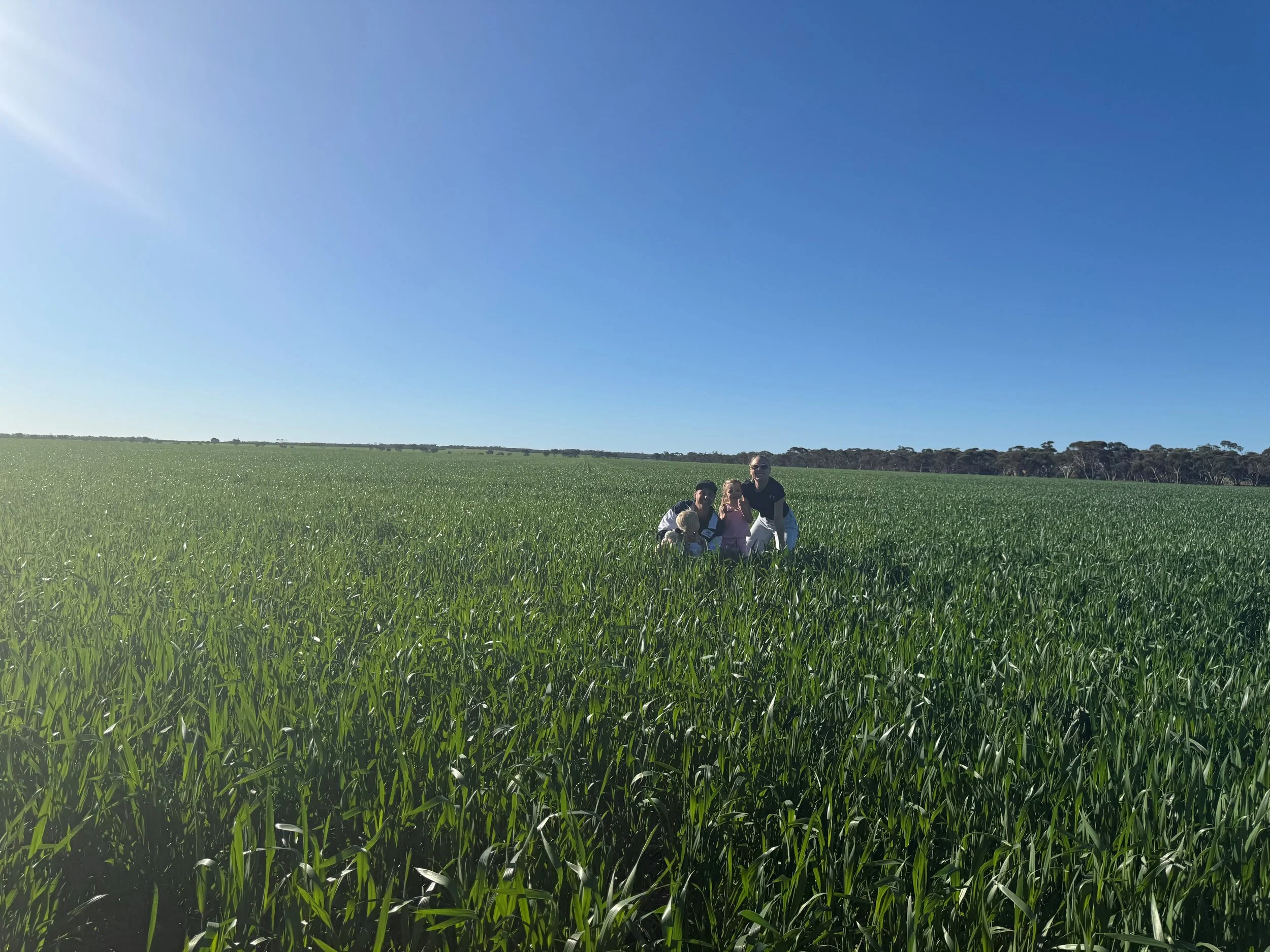
Photo caption: WA farmer Ben Farina, Warralakin, pictured with his daughters, Billie and Noa, is all smiles after generating significant soil carbon on the family’s property with support from LawrieCo and AgriProve.
ANOTHER Western Australian farmer has pocketed more than 3000 Australian Carbon Credit Units (ACCUs) after building measurable soil carbon on his family’s property, marking the second issuance in the State and demonstrating it can be done in dryland broadacre cropping areas.
Ben Farina and his family operate a 6400-hectare mixed cropping and sheep enterprise in a 300mm rainfall zone near Warralakin in WA’s eastern wheatbelt and they have been improving soil health practices as part of a carbon project set over about 670ha of cropping land.
The project was developed with AgriProve under the Australian Government’s Emissions Reduction Fund (now ACCU Scheme) in June 2022, with carbon abatement measured through to July 2025.
The project earned a total 3327 ACCUs, representing about 5 tonnes of carbon dioxide equivalent per hectare over the measured period, or an annualised rate of around 3.85t/ha/year, based on the soil sampling interval.
Ben said their move toward soil health and carbon farming commenced in response to rising input costs and declining fertiliser efficiency.
“We were finding we had to apply more fertiliser each year, but were seeing less response from the crops,” Ben said.
“That forced us to step back and rethink how we were managing our soils.
“Initially the motivation was economic, but over time, the soil health side of it became just as important. Building healthier soils improves moisture retention, resilience and the long-term sustainability of the farm.”
The enterprise produces wheat, canola, lupins and chickpeas alongside a Merino sheep flock, and the family worked closely with LawrieCo to implement soil health and carbon-building practices across the project area. This included the use of humates, biological inputs and targeted nutrient applications to address key soil deficiencies and support plant and root development.
Rodney Capon, Carbon and Biological Agronomy Specialist at LawrieCo, said carbon sequestration had historically been considered challenging in low rainfall environments, but the project on the Farina’s farm showed soil carbon gains were achievable for growers in these areas.
He said it highlighted the role of soil biology and balanced nutrition in improving both farm productivity and measurable carbon outcomes.
“When the focus is on improving soil biology, nutrient balance and root development, it shows farmers what can be achieved in low rainfall regions and how they can build soil carbon,” Rodney said.
“Practices that improve microbial activity and nutrient efficiency not only support crop productivity, but also help build long-term soil carbon.
“Importantly, projects like this demonstrate that these improvements can be measured and verified, giving confidence to growers and the wider carbon market.”
AgriProve General Manager Kieren Whittock said the Farina’s success signalled a real opportunity for broadacre cropping farmers.
“Ben’s results are a testament to what’s possible when a farmer commits to building biologically active, healthy soils. There is a real opportunity for broadacre farmers to participate in soil carbon projects and be rewarded for implementing practices that benefit both their land and their long-term productivity.”
Rodney said the project further builds on a growing number of soil carbon success where LawrieCo soil health systems have supported measurable carbon outcomes in dryland cropping regions.
“We’ve now seen soil carbon credits issued on several broadacre cropping farms using similar soil health approaches, including near Kavina and Birchip in Victoria and Goomalling in Western Australia.”
“All of these farms operate in relatively low rainfall cropping regions, so it’s exciting for other growers in these areas who may be deliberating over commencing a soil carbon project.”