
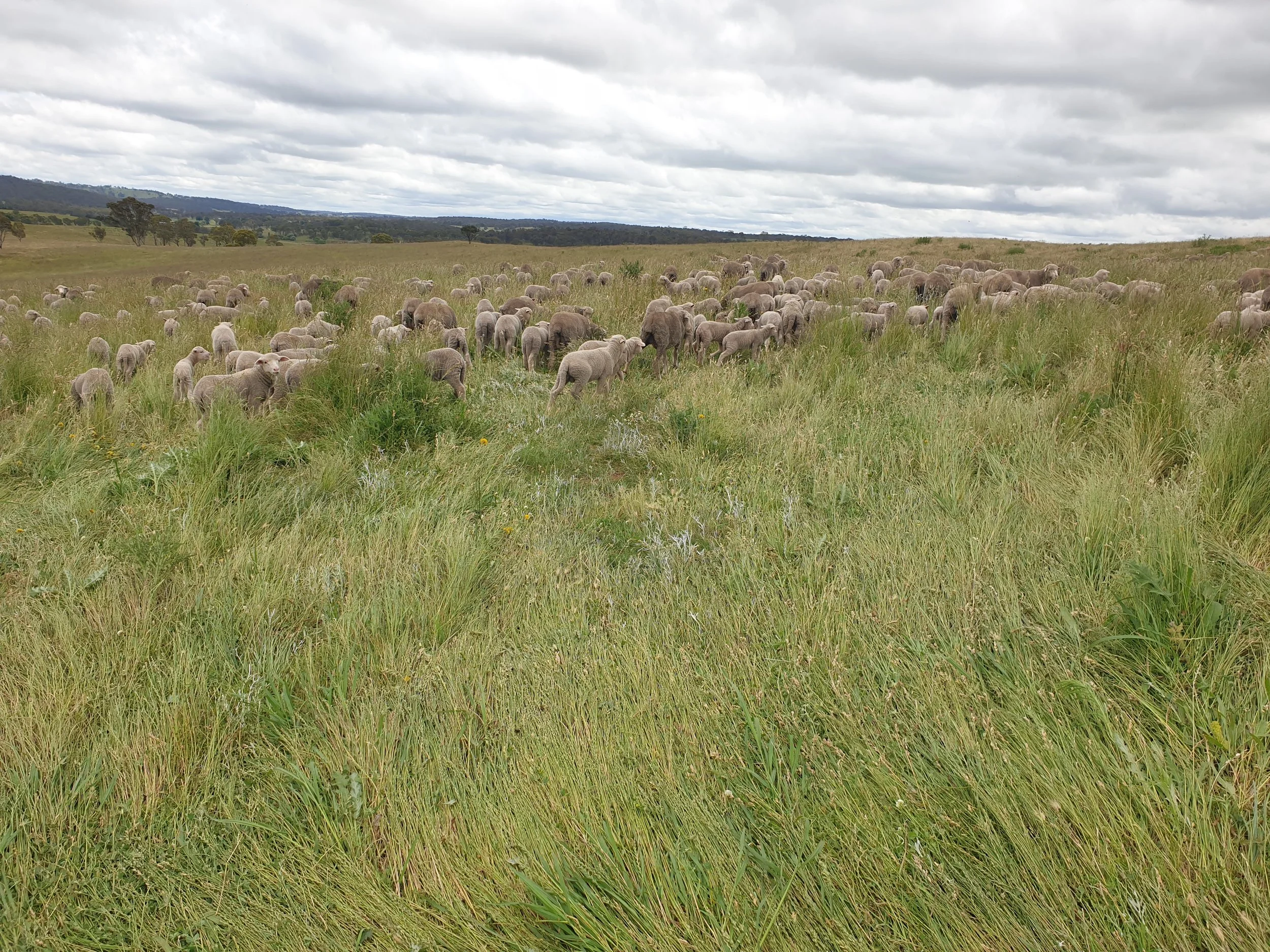
The McClean Carbon Project, owned and managed by Justin Hoad, has achieved successful issuance of ACCUs under the ACCU Scheme, validating measurable increases in soil carbon across his Northern Tablelands NSW grazing property.
The project sits within a ~400-hectare self-replacing Merino and cattle enterprise, reflecting a commitment to biological farming, infrastructure investment and pasture improvement, with carbon measurement now independently quantifying the outcomes.
Justin Hoad has been issued 5,012 ACCUs, recognising measurable soil carbon improvement achieved through sustained changes to grazing management and land stewardship.
07 May 2026: The McClean Carbon Project, owned and managed by Justin Hoad at North Mihi, Uralla on the Northern Tablelands in New South Wales, has reached a significant milestone with the issuance of 5,012 Australian Carbon Credit Units (ACCUs) under the Australian Government’s ACCU Scheme.
Developed in partnership with AgriProve, the project covers approximately 350 hectares of Hoad’s 400-hectare mixed enterprise and reflects a long-term commitment to improving soil health, pasture resilience and livestock productivity. The ACCUs issued validate measurable increases in soil organic carbon achieved through practical, farm-led management decisions.
Justin has been progressively implementing biological farming practices, expanding from 15 paddocks to nearly 70 subdivisions, installing reticulated water infrastructure across approximately 12 additional water points, consolidating livestock mobs, and replacing synthetic fertilisers with composted organic matter. While these practices were adopted to strengthen the performance and resilience of the broader farming business, the soil carbon project is measuring and validating the continued improvement in soil health and carbon outcomes achieved through ongoing management refinement.
“People should be going towards biological farming and improving soil carbon regardless of a project.” Justin Hoad
Justin Hoad, McClean Carbon Project Across the ~400-hectare operation, investment in fencing, water points and pasture establishment has supported controlled grazing with short grazing periods and adequate rest and recovery. The consolidation of livestock mobs has enabled more effective pasture utilisation while reducing labour demands and chemical inputs. Stocking numbers have grown from approximately 1,900 mostly dry wethers in 2012 to more than 1,000 Merino sheep and 200 cattle both self-replacing today.
The property has also demonstrated improved resilience through significant rainfall extremes. The district recorded its lowest annual rainfall in 70 years in 2019 at 280 mm, followed by a record high the following year of over 1,200 mm against a long-term average of approximately 780 mm. Through both extremes, Justin observed that the property responded to rainfall faster and held pasture cover longer than neighbouring properties.
“We seem to be able to respond quicker to rainfall than the neighbours and hang on a bit longer when it stops raining. We’ve also carried the most stock in the last few years compared to when we first started.”
The soil carbon project was established after careful consideration of measurement accuracy and long-term practicality. Justin selected AgriProve based on its soil-first approach and shared-success model, where monitoring, sampling and reporting are directly aligned with measurable outcomes achieved on-farm.
“There is a fair bit of work involved, and it does take longer than you might expect. But once the project is up and running, it becomes more straightforward. My advice is to have your records in order before you start and to work with a team you can trust to handle the regulatory side of things.”
Quotes attributable to AgriProve General Manager, Kieren Whittock:
“The McClean Carbon Project demonstrates what is achievable when a focused commitment to biological farming is backed by rigorous soil carbon measurement. Justin has made significant infrastructure and management changes, and the ACCUs issued are a formal validation of those outcomes.”
“At AgriProve, we take a soil-first approach because productivity and carbon are inseparable. When soils improve, pasture utilisation improves, stocking rates lift sustainably, and businesses become more resilient. This issuance shows what’s possible when good farming and robust measurement come together.”
Media contact: Daniel Wortmann | 0448 187 650 | [email protected]