
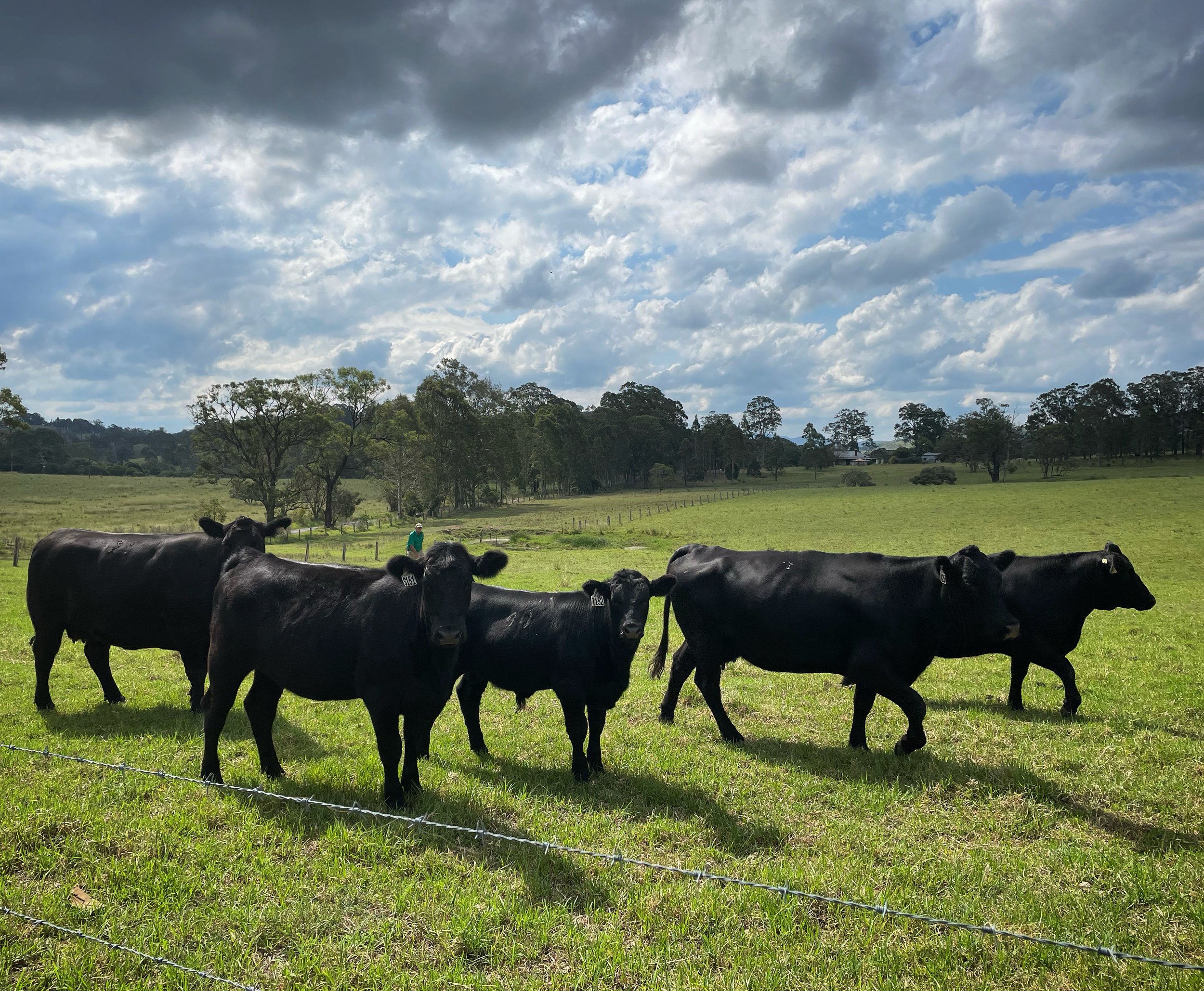
Dungog landholder John Monaghan and business partner Alan Smith have received a second issuance of 3,950 Australian Carbon Credit Units (ACCUs) on the McLachlan Carbon Project at Rocking Chair Farm, Marshdale, taking the project to a cumulative total of 6,060 ACCUs under the ACCU Scheme.
The McLachlan Carbon Project is among just five soil carbon projects nationally to reach a second (T2) round of ACCU issuance under the 2021 soil carbon method, showing that soil carbon gains measured in the first round have held and continued to build.
The second-round gains were measured following a run of highly variable seasons, with the herd sold down by roughly half to protect groundcover and avoid overgrazing.
20 October 2026: Dungog landholder John Monaghan and his business partner Alan Smith have received a second issuance of 3,950 Australian Carbon Credit Units (ACCUs) on the McLachlan Carbon Project, taking the project to a cumulative total of 6,060 ACCUs and making it one of only five soil carbon projects in Australia to reach a second (T2) round of credits under the 2021 soil carbon method. The project covers around 73 hectares of Rocking Chair Farm at Marshdale, near Dungog on the NSW Hunter, which they run together as a mixed cattle, sheep and pastured egg operation.
Mr Monaghan and Mr Smith received their first issuance of 2,110 ACCUs in September 2023, the first soil carbon ACCUs issued in New South Wales. The second round, covering the reporting period from February 2023 to November 2025, adds a further 3,950 ACCUs and confirms that the soil organic carbon measured in the first round has not only held but continued to grow.
The project was baselined in early 2021 and registered in January 2022. Re-sampling in December 2022 delivered the first 2,110 ACCUs, before the November 2025 soil sampling round delivered the second issuance of 3,950 ACCUs.
The project is built on grazing management. Since joining AgriProve in 2021, the property has been subdivided from seven paddocks into 25, supported by new fencing and watering infrastructure. Cattle are moved on an adaptive rotation that targets around four days per paddock but is set by available feed. Smaller paddocks may carry stock for a single day, while the best paddocks are strip grazed, with one paddock providing close to 20 days of grazing through daily moves. Multi-species pastures have been sown across the farm, and synthetic fertilisers and herbicides have largely been removed from the system.
The result has been achieved through some of the most variable seasons Mr Monaghan has seen in more than 30 years on the farm. The project began as the district emerged from the 2018 to 2019 drought, followed by several near-normal years, a prolonged wet period that waterlogged paddocks, and alternating wet and dry spells since. In response, the cattle herd has been reduced from around 95 cows and calves to about 50 to match stocking rates to available feed.
Rocking Chair Farm is also one of three demonstration sites in Meat & Livestock Australia's Producer Demonstration Site program run by AgriProve, which is testing how multi-species pastures affect soil carbon, pasture productivity and the carbon intensity of livestock businesses.
Carbon income is being reinvested across the farm. Planned works include shade and timber trees along fence lines, creeks and gullies, leaky weirs to slow water and build biodiversity, and infrastructure for a council-approved pastured egg enterprise. The business has also moved into direct sales, with lamb and monthly beef boxes sold straight to customers. Mr Monaghan and Mr Smith also host two to three workshops a year on the property, sharing what has worked with other landholders in the district.
With the grazing infrastructure now largely in place, Mr Monaghan and Mr Smith are turning to the next layer of soil and pasture management. Over the past six months the farm has started applying biological foliar sprays after grazing, built around a Johnson-Su compost brewed on farm over 12 months, along with fish emulsion, seaweed, molasses and targeted trace elements such as boron and molybdenum. Brix readings taken before and an hour after spraying have lifted from around 5 to 7 to between 8 and 10, and side-by-side photos show visibly stronger regrowth within a week. The program began after the latest sampling round, so it played no part in this issuance, but it forms part of the farm's plan for the next crediting period. The pair are now working with neighbouring farmers to brew inputs locally and reduce costs.
This second round ACCU issuance was HORIZON informed. HORIZON is AgriProve’s soil organic carbon (SOC) model, which combines satellite imagery with soil sampling data to predict changes in soil carbon. It estimated an increase on the McLachlan Carbon Project, and then the AgriProve team re-sampled those projects. The November 2025 soil sampling confirmed the gain the model had predicted. Results like this help validate HORIZON as AgriProve moves toward Schedule 2 of the 2021 soil carbon method, a measure-model-measure approach that allows modelled estimates to be used between physical sampling rounds.
Quotes attributable to McLachlan Carbon Project landholder John Monaghan
"I think the carbon just comes from the rotation. We're not putting on synthetic fertilisers or using herbicides, and I think that's what's having the effect. The sprays we've started since will enhance the growth and hopefully give us a better response again."
"There's no strict regime of four days in each paddock. It's about how you don't overgraze, but graze hard enough that they're covering the whole paddock and then move them on. It's really about adapting to the climate and the conditions that are there."
"We've had really wet winters and then really dry springs and summers. The rain we're getting now comes in storms rather than steady soaking rain, so it's important to be able to capture as much of it as we can. It's forced us to make some really different and hard decisions on stock numbers."
"To us, the carbon credits are a huge bonus. Over a bit more than five years we've got around 6,000 credits. The cattle and sheep cover their costs and our living expenses, and the carbon gives us the cream on top that allows us to do other things on the farm." "We're a small farm, but that's a pretty significant contribution to our business."
Quotes attributable to AgriProve General Manager Kieren Whittock
“John and Alan have shown what disciplined grazing management can do for soil carbon. They split seven paddocks into 25 and move stock based on feed rather than the calendar. They’ve also built diversity back into their pastures. That work has not only held the carbon from the first round but kept it building.”
“What stands out is how they’ve managed through some challenging and variable seasons. Roughly halving the herd to protect groundcover is a hard call for any producer. This result shows that putting the soil first pays off. They’re also generous with what they’ve learned and open the farm for workshops so other landholders can see it for themselves.”
“More and more landholders are looking at the carbon in their soil as another source of farm income. With multiple ACCU issuances now more common, that’s exactly how they should see it. This isn’t a science experiment. It’s a commercially viable income stream that sits alongside livestock and cropping and deserves to be taken seriously as part of the business.”
Media contact: Daniel Wortmann | 0448 187 650 | [email protected]