
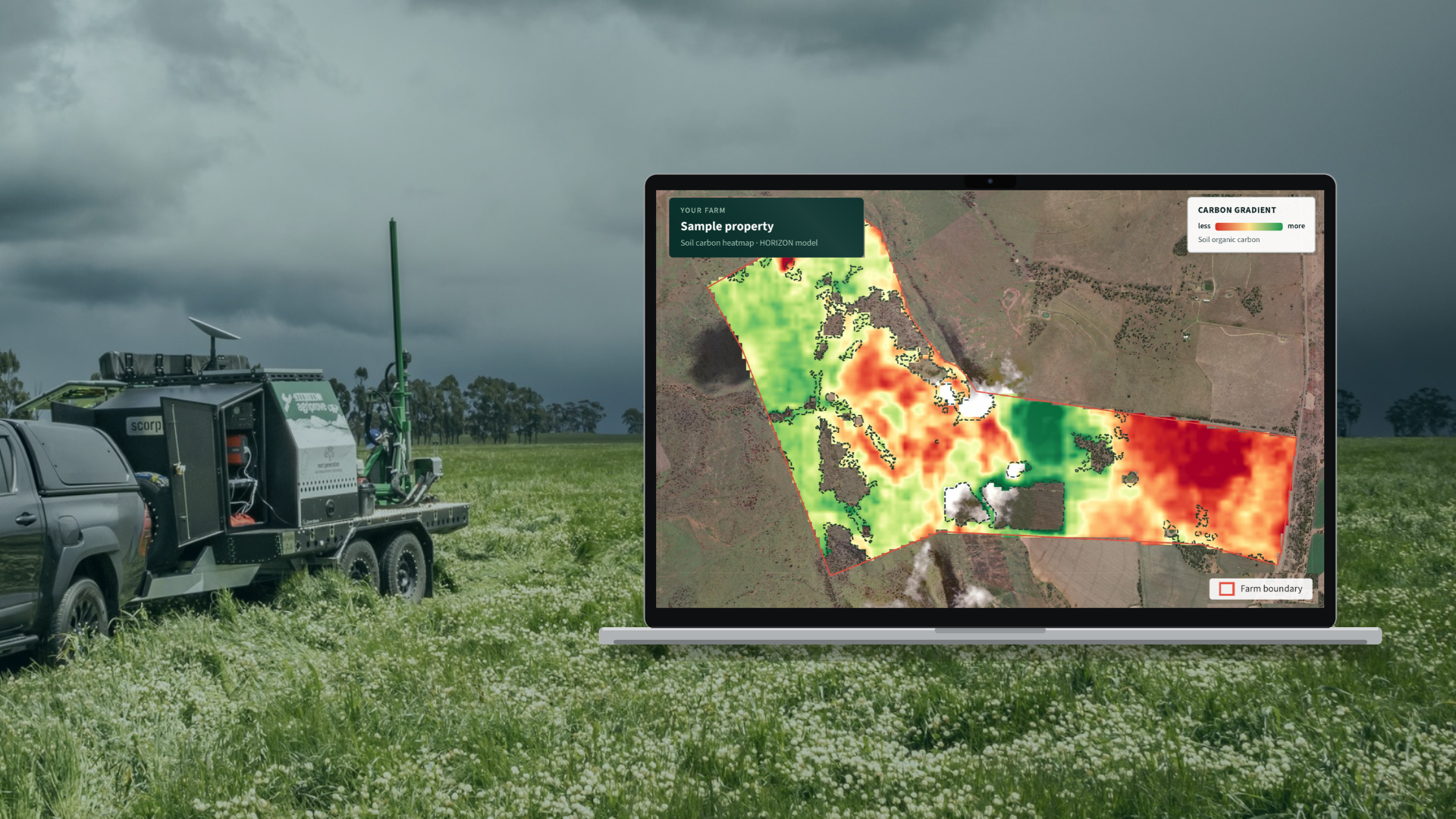
One round of validation soil sampling across 21 projects and 4,129 hectares using AgriProve’s proprietary HORIZON digital twin platform. Soil carbon credits can now issue every year.
Albury, NSW, 04/11/2026: AgriProve has lodged Australia’s first soil carbon crediting application built on a digital twin of the soil. HORIZON, AgriProve’s digital soil model, estimates the carbon in every 30-metre square of every paddock, every year. One round of physical soil sampling validated the model across 21 projects and 4,129 hectares. Until now, each soil carbon project has waited for a separate sampling round before it could be credited. Validating the group in one round moves soil carbon to annual crediting.
Digital twin, checked against the soil: HORIZON calculates soil carbon content from about 46,000 points across the first group, with up to 313 predictors per point, calibrated against physical soil samples.
21 projects, 4,129 hectares, one validation: the validation comprised 596 hectares sampled across the group at random, above the soil carbon method required minimum in both hectares and sampling points.
Same carbon credits, measured a new way: Australian Carbon Credit Units (ACCUs) rely on conservative estimates, with bias correction, variance discounts and physical sampling validation built in.
Two paths under Schedule 2
Schedule 2 of the 2021 soil carbon method opens two paths. In the first, the model assists and speeds up physical measurement, and the soil sample remains the primary estimate. In the second, the model is the primary estimate and physical soil samples validate the model. The Clean Energy Regulator has issued credits under the first path. AgriProve’s application is the first group-scale use of the second path, the digital twin, in Australia. The model and data behind this application are one component of AgriProve’s digital Monitoring, Reporting, and Verification (MRV) stack, designed to deliver transparency, confidence and traceability across the project record and therefore full auditability of every claim.
What this means for farmers
Credits can issue every year, rather than every 3 – 5 years between sampling rounds.
Physical soil sampling still anchors every project. Baseline samples set each farm’s starting point, and group validation samples check the model from there.
A farm no longer waits for a separate sampling round before the first credits.
Producers and growers keep undertaking the management changes registered with their project, and the reward arrives sooner and more often.
What this means for the market
Supply becomes annual and plannable, rather than lumpy and infrequent.
Buyers can build portfolios around steady yearly delivery from the same group of farms.
The Australian Carbon Credit Unit (ACCU) does not change. The Clean Energy Regulator issues the same unit, under the same scheme and audit requirements.
Quotes attributable to AgriProve Founder Matthew Warnken
“This is a breakthrough for soil carbon in Australia. Schedule 2 allows a model to estimate soil carbon, provided physical sampling validates the model. That rule has existed since 2021 and now the technology to meet it exists. HORIZON is a regulatory-grade digital twin of the soil, checked against physical soil samples.
“Soil carbon has been held back by the time and cost of measurement, not by the integrity of the method. Validating a group of farms in one round removes that bottleneck. That is how soil carbon reaches the scale the market needs, without giving up the measurement that makes a carbon credit worth having.”
Quotes attributable to AgriProve General Manager Kieren Whittock
“Farmers have been asked to produce more and better food, year after year, for less. Almost every efficiency gain in agriculture flows up the value chain away from the farm gate. This benefit flows directly to the farmer, as a carbon payment accessible every year soil carbon increases.”
“Producers already trust Meat Standards Australia to grade their beef with a model checked against measured data. HORIZON does the same for soil carbon, checked against physical soil samples.”
How it works
Under Schedule 1, each project waits for a separate sampling round before any credits can issue. The approach is sound but slow. One in 19 registered soil carbon projects has received credits to date using this approach. Schedule 2 lets one round of validation sampling cover a group of projects. For the first group, AgriProve drew validation sample sites at random to test the model. AgriProve then calibrated HORIZON against those samples and applied the model to every 30-metre square in the group.
The first application is now with the Clean Energy Regulator for assessment. The project behind it is one of 16 in the group that showed a measured increase in soil carbon. AgriProve expects the other 15 to follow once each meets audit requirements. Across those 16 projects, the company expects about 70,000 ACCUs to be issued by mid-2027. AgriProve now plans to move the full portfolio to Schedule 2 over the next 12 months. HORIZON’s preliminary estimate for that portfolio is about 700,000 ACCUs.
Faster crediting does not mean lower integrity. Credits in this application rest on conservative statistics. The calculation deducts any bias measured against physical samples and discounts the remaining uncertainty. A 25 per cent temporary discount applies to the first two estimation events. Every project within a group must also be physically sampled within 10 years.
AgriProve developed HORIZON with support from the Australian Government’s National Soil Carbon Innovation Challenge.
Media contact: Daniel Wortmann, National Marketing and Promotions Manager, 0448 187 650, [email protected]