
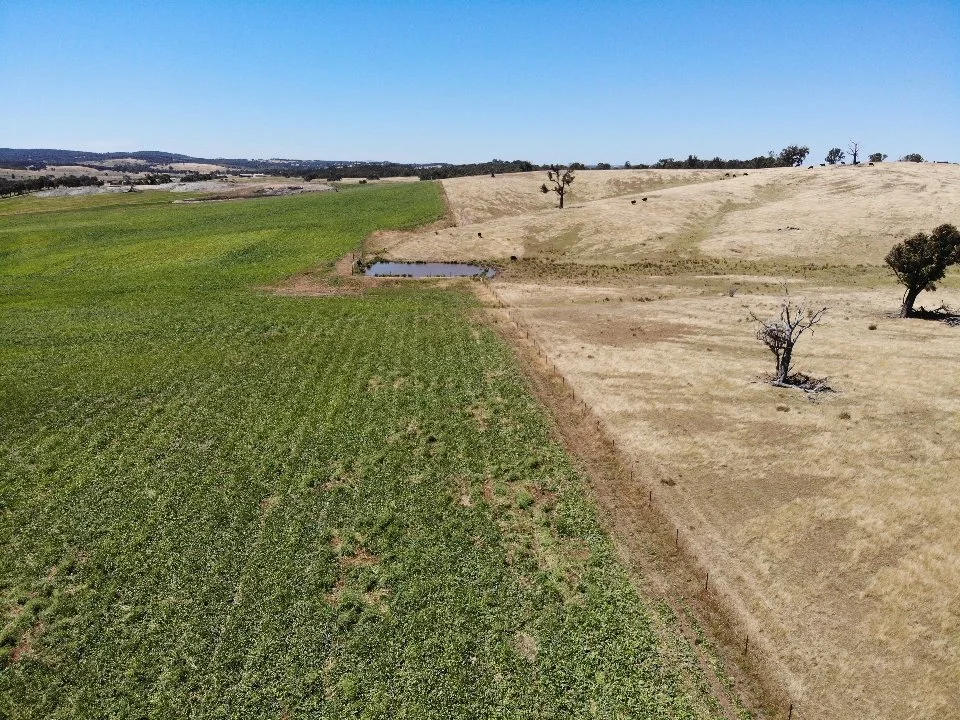
Killen Carbon Project, New South Wales
Blakney Creek landholders John Lawson and Philippa Yelland have received a second issuance of Australian Carbon Credit Units (ACCUs) on their Killen Carbon Project under the ACCU Scheme, taking the project to a cumulative total of 2,996 ACCUs.
The Killen Carbon Project is among just four soil carbon projects nationally to reach a second (T2) round of ACCU issuance under the 2021 soil carbon method. Most significantly, this result demonstrates that earlier soil carbon gains have held and continue to grow.
The first of the project's three strata to complete the full treatment programme recorded a simple mean soil organic carbon gain of 1.69% in the top 30cm at T1, reaching 2.03% cumulatively by T2.
The livestock carrying capacity is continuing to run at roughly double the baseline in good seasons
11 June 2026: Husband and wife landholders John Lawson and Philippa Yelland have received a second issuance of 1,285 Australian Carbon Credit Units (ACCUs) on their Killen Carbon Project, taking the project to a cumulative total of 2,996 ACCUs and making them one of only four landholder groups in Australia to reach a second (T2) round of credits under the 2021 soil carbon method. Their 47.25 hectare project, 25 kilometres north-east of Yass on the NSW Southern Tablelands, sits alongside the couple’s cattle grazing operation.
The T2 result confirms that the soil organic carbon measured during the first round has not only held over time but continued to grow, with the most recently completed soil sampling carried out at the end of a dry period. The Killen Carbon Project is the fourth soil carbon project to be issued ACCUs for the second time (T2 Soil Sampling Round).
Mr Lawson and Ms Yelland received their first issuance of 1,711 ACCUs in September 2024, with the second round adding a further 1,285 ACCUs.
The project draws on the same soil-remediation programme that underpinned the first-round result, combining non-synthetic fertilisers and soil amendments with deep sub-soil incorporation to correct pH, address macro and micronutrient deficiencies, and improve soil structure and biology. Inputs include drinking water lime residuals, paper crumble, crusher dust and AgriAsh - industrial by-products that might have gone to landfill in earlier times, repurposed into agricultural inputs under EPA resource recovery orders.
Contracts with SUEZ and Opal, a recycling, paper and packaging company, have enabled an extended science-based approach to the soil treatment programme, with AgriAsh and crusher dust suppliers also contributing. The treatment programme has been applied across the full carbon estimation area in three sequential stages across the strata, with the soil carbon response tracking the progression of the programme rollout. Alongside the carbon outcome, the soil treatment programme has continued to lift the productivity of the land. This circular economy project required substantial inputs of recycled organics, but the incorporation process ensured the added carbon was both preserved and increased.
Treated paddocks have run roughly double the carrying capacity during good seasons compared with the baseline period, with average bulk density across the project dropping from around 1.6 to 1.4 tonnes per cubic metre- opening up pore space and lifting water-holding capacity - and soil pH lifting from a low of 4.2 into the mid-6 to 7 range.
Mr Lawson’s expertise in soil health and regeneration extends beyond the farming operation, with his other business, SoilRegen (www.soilregen.com.au), focusing on sustainable soil improvement solutions for Australian farmers. In 2025, SoilRegen - in partnership with SUEZ - won the Australian Water Association (NSW) Heads of Water Award for Research and Development Excellence, with the Killen Carbon Project contributing to the recognition. Like all of AgriProve’s projects, Killen benefits from AgriProve’s digitally enabled Soil Organic Carbon (SOC) model, which combines satellite imagery with ground-truthed measurements to predict changes in soil carbon. This remote SOC monitoring allows re-sampling to occur once an increase in soil carbon is predicted, significantly speeding up the crediting process.
Mr Lawson and Ms Yelland are now considering expanding the Killen Carbon Project by a further 52 hectares with AgriProve, more than doubling the existing carbon estimation area under the same treatment approach.
Quotes attributable to Killen Carbon Project landholder John Lawson
"We’ve not only held the carbon from the first round of measurement, but we’ve substantially increased it. That’s the key news. It demonstrates that you can not merely hold soil carbon, but you can keep building it."
"One of the aspects we’re most proud of is our focus on soil and materials science to support a circular economy. We incorporated the products quite deeply - it wasn’t just surface applied. That incorporation intensity is something we want to highlight, because it changes the soil structure, drops the bulk density and lifts water-holding capacity. And you can’t have a carbon increase without water."
"Our project employed seven separate techniques across three strata, and AgriProve scheduled their SOC monitoring across each of those strata, which has clarified the value of different treatments. The completed section gained 1.69 per cent of soil organic carbon in the top 30 centimetres in under two years, and the second round has added another 0.34 per cent on top."
"Carbon farming revenues will enable more productive projects like ours, but capital risk management will require the kind of expertise in which AgriProve is a vital partner and the acknowledged leader."
Quotes attributable to AgriProve National Operations Manager Kieren Whittock
“John and Philippa’s project is one of only four soil carbon projects in Australia to reach a second round of ACCU issuance under the 2021 method. What makes this result particularly compelling is John's depth of soil health expertise and the programme he's designed with its focus on sub-soil incorporation of carefully selected amendments. This has resulted in a marked change to the soil structure and has demonstrated that carbon is not just being maintained but building.”
“Across our portfolio, we're issuing ACCUs at close to a monthly cadence, with nearly 50 projects credited. Killen Carbon Project is part of a growing cohort demonstrating that second ACCU issuances are possible. As HORIZON our soil organic carbon model capability continues to mature, that pace is only going to accelerate”
Media contact: Daniel Wortmann | 0448 187 650 | [email protected]